
This is a bit boat maintenance technical so if that is not your thing I suggest you skip this one. Unless you want to read about me being humbled 😉
After being in Chania for a few days we decided to leave and head to our next public dock in Crete. Chania is an amazing old city but it is very touristy and crowded. We will come back when there are less people.
We had motored out of the port and were maybe 5 minutes out and I had engaged the auto-pilot and gone to the front to secure the anchor (i.e. tie it off so it doesn’t decide to fall off after a big wave) when suddenly I hear Victoria yell “Something is beeping in the cockpit”!!! I figured this was an AIS test message (which we get occasionally) which was scary the first time (what the heck is this!) but you just have to select ‘OK’ on a display and they go away.
I make my way back to the cockpit and there is a different beeping…..it is the engine overheat alarm! YIKES!!! The engine temperature is always rock solid at just under 80 degrees C and now it is just over 100. I throttle back the engine to neutral and then turn the engine off. We are some ways from shore so it is not really an emergency, and I check the depth and ironically we can drop anchor here if we have to (I think we were in 20m or so and we have 75m of chain). There is a bit of wind so we can also sail away if we have to.
One of the tools I was told would be useful is an infrared temperature gun. You point it at something and it gives you the temperature. I go grab it and open up the engine bay and start checking temperatures. I don’t remember all of them, but I do remember that everything actually seemed cooler than I expected. 45 degrees. 80 degrees but nothing close to 100. This puzzles me.
We sit for a bit and then I start the engine again. The engine runs OK and the temperature has reduced and the warning light is no longer on. I decide to try to slowly motor back into the harbour. What if the engine starts to overheat again at the worst time? I should mention that Chania harbour entrance has a green buoy on the west side going in, and massive rocks just further west which are a bit scary. Apparently a few boats have ignored their charts and driven right into them. My eyes are locked on the temperature gage as we crawl back into the harbour.
So the usual cause of engine overheating is having your saltwater impeller go bad. These boats push saltwater with a rubber impeller through a cooling unit with cooling fluid on the other side (called the freshwater side) and the cooling fluid is then pushed around the engine with another pump (which rarely needs servicing. I suspect the rubber impeller is used on the saltwater side because it can handle small debris which doesn’t happen on the freshwater side).
Victoria calls the harbour guy and since this should be a quick fix we tie up alongside one of the piers. He thinks it is the impeller as well.
I check the cooling overflow and it is very full. I have a spare impeller but it looks used, so I go to the boat store and buy a replacement.
I’ve heard that removing these impellers is hard, and there is a special tool to do it which I don’t have, but you can slowly work them out with needle nose pliers. You remove 4 small bolts to a plate and you can see the impeller. However it is on the ‘other’ side of the engine, so I have to lie across the engine and I can’t get both of my hands there at once.
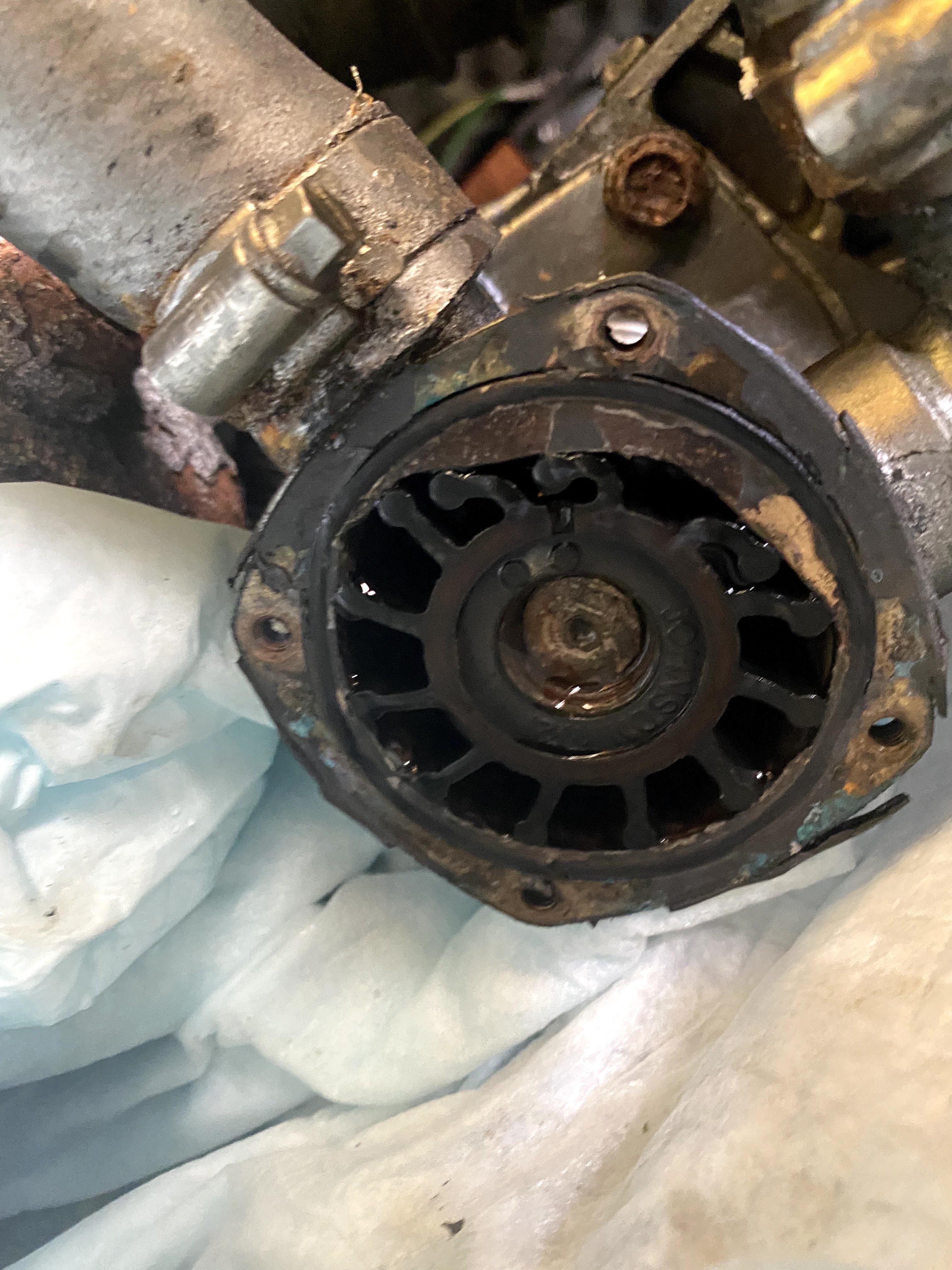
Removing the impeller is a life changing experience. I now know that if I keep trying it will happen eventually. I came close to giving up…..going around and around with the pliers, tugging at the rubber arms, nothing happening, continuing, continuing until finally it begins to budge (you are not supposed to put screwdrivers in and start prying because you will scratch the housing). Plus the engine is still warm and you are twisted around in a small space. Big fun. Putting the new one in is easier because it gets lubricated with a gel, and I remember a trick of using a zip tie to compress the rubber arms. It slips in relatively easily. I replace the cleaned plate and we are done.
I look at the old impeller. It looks brand new! Usually one of the arms breaks off or is damaged which stops the water flow but this looks totally fine.
But we’ve done our repair and off we go! We get off the dock and out of the harbour and OMG the engine is still over-heating! The buzzer has not gone but we are around 90 degrees and something is not right, so I again throttle back and crawl back into the harbour. This time we dock backwards so we have more time to think about things. (By this time we are pros at the backwards Med mooring technique.)
I email my Amel expert Bill Rouse and tell him what I have done and what has happened, and he tells me to clean the transmission oil cooler. This is a saltwater cooler and the water goes through this before it gets to the engine, and because it has little honeycomb holes they can get clogged with crap and reduce the waterflow and hence the cooling. (The Amel saltwater intake has a filter of course but small particles can still get through.)
So with a puppy pad under the engine to catch the saltwater (saltwater is the enemy in the engine room it is like acid) and my WetVac running right beside I loosen the connection to the oil cooler and pull off the hose. This is super easy! And the honeycomb holes look clogged! And there is a bunch of crap just before here! This is so great!


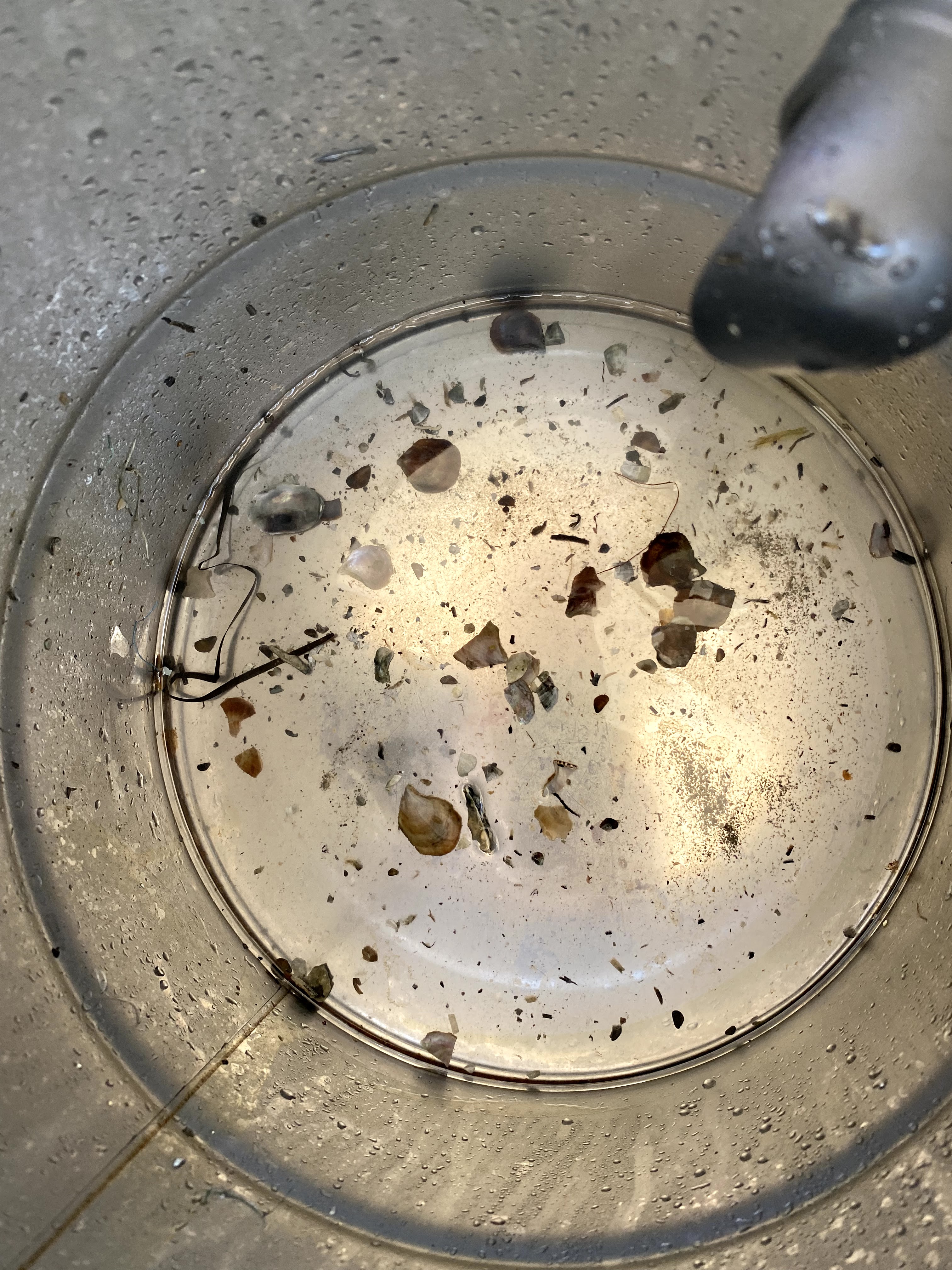
I was very happy about this. This was easy to do and clearly I had cleaned up a bunch of crap restricting water flow, and after starting it did look like we were spitting out more water.
So the next day we again head out. It was windier now and there were 2m+ waves coming into the port. We just get past the green buoy and I can see the temperature creeping past 80 to 90…..we still have the same problem!!!! OMG!!! And now we have some decent wind pushing us back and we are in decent waves. And we are close to the big rocks at the port entrance. I throttle back and motor a bit further out so we can safely turn, and tell Victoria to hang on because we might catch a wave sideways which could rock us around a bit. The boat turned beautifully and we hardly moved which was nice and I again slowly motor back into port.
At this point my Amel guy says I should call in an expert, because if I mess up I can ruin the engine, so we call the local port Diesel guy Vassilis.
We end up waiting 2 days for him (partially our fault we missed him the first day) and when I’m down looking at the engine I decide to take off the main coolant cap to take a look. Remember the coolant overflow is totally full. And I can’t see any coolant!!!!!!! How can this happen!!!!! Also when i remove the cap all of the coolant in the overflow begins draining into the engine.
I read up on this, and boat engine coolant caps have 2 valves: one to let the excess coolant flow into the overflow when it gets hot, and another to let the coolant come back in when it cools. I suspect I have a bad coolant cap. I go to the chandlery and I order one from Yanmar in Athens (we are waiting for it to arrive).
At this point I’ll mention that if I was more experienced I would have suspected a freshwater coolant issue at the beginning even without seeing the low coolant. The clues were the temperatures I took of the cooling system from the top of the engine. The parts that should have been hot because of heat transfer in the cooling system were not hot enough. I’ll make better notice of this next time.
The engine guy comes and I tell him what I’ve done so far and about the coolant and he starts to take apart the freshwater/coolant side. He removes the thermostat (the next thing I would have replaced) and cleans it. Then he drains and uses a coolant cleaning liquid on the engine. We run the engine for a bit and when he drains it he shows me how dirty it is. He then replaces the thermostat and re-fills with new coolant. We take the boat out of the harbour and the temperature is now rock steady just under 80 as it was before.
I’m still waiting for my new radiator cap……and also when I checked the coolant level under the cap it was down a little bit. Do I have a coolant leak somewhere? Is this normal because there was a little air in the system? (the diesel guy spent a lot of time getting air out apparently this is a common bad thing you need to avoid). I finally found the weeping hole on the freshwater pump and it looked clean, so no leak from there.
Anyway I added a few cups of coolant. My faulty cap could still be causing this I think. It could be letting coolant flow out but not back in.
Stay tuned.
 Adventures on Spruzzo