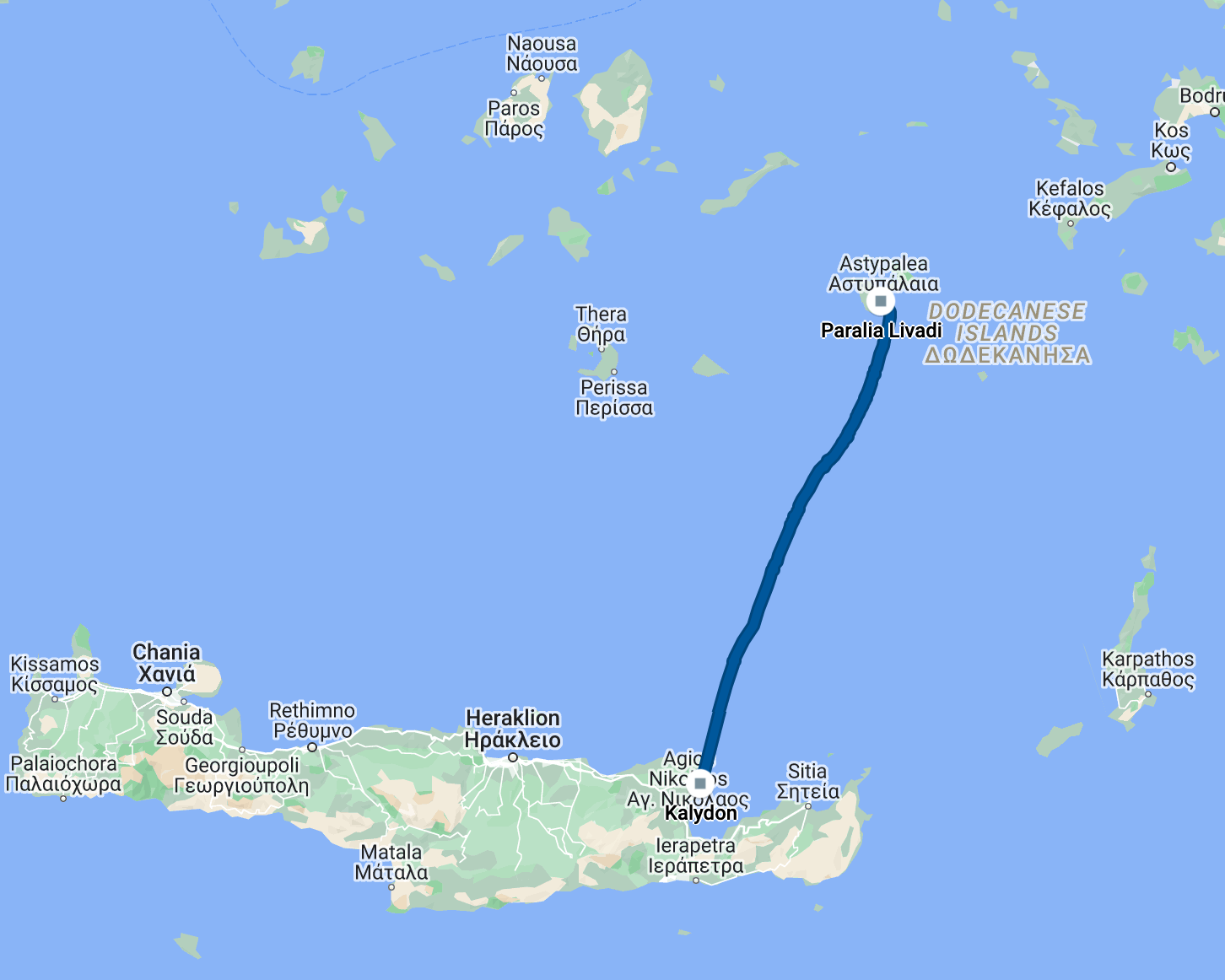
On Friday June 3rd we headed out to a small bay just north of the marina of Agios Nikolaos in Crete. The idea was that on Saturday, the winds were predicted to be mostly from the west and a good strength (15-20 knots or 28-37 mph): so perfect for us heading north to Astypalia. In the Greek summer, the winds are almost consistently strong from the north, so any east/west wind is good for heading north (i.e. not into the wind). We had 80 nm (or 150km) to travel. We were travelling with a buddy boat: friends from the marina (another Amel) and their boat’s engine tends to overheat so we decided to travel together and try not to use our engines. If we averaged 5 knots of speed it would take us 16 hours of travel so we needed every minute possible of sailing to make it before sunset (anchoring in the dark is not great).
We left at 5am with just a sliver of moon for visibility. I let Victoria sleep and raised the anchor myself and with our buddy boat we motored out of the bay and north. We had very little wind for the first hour or so, but I did get to see a spectacular sunrise.
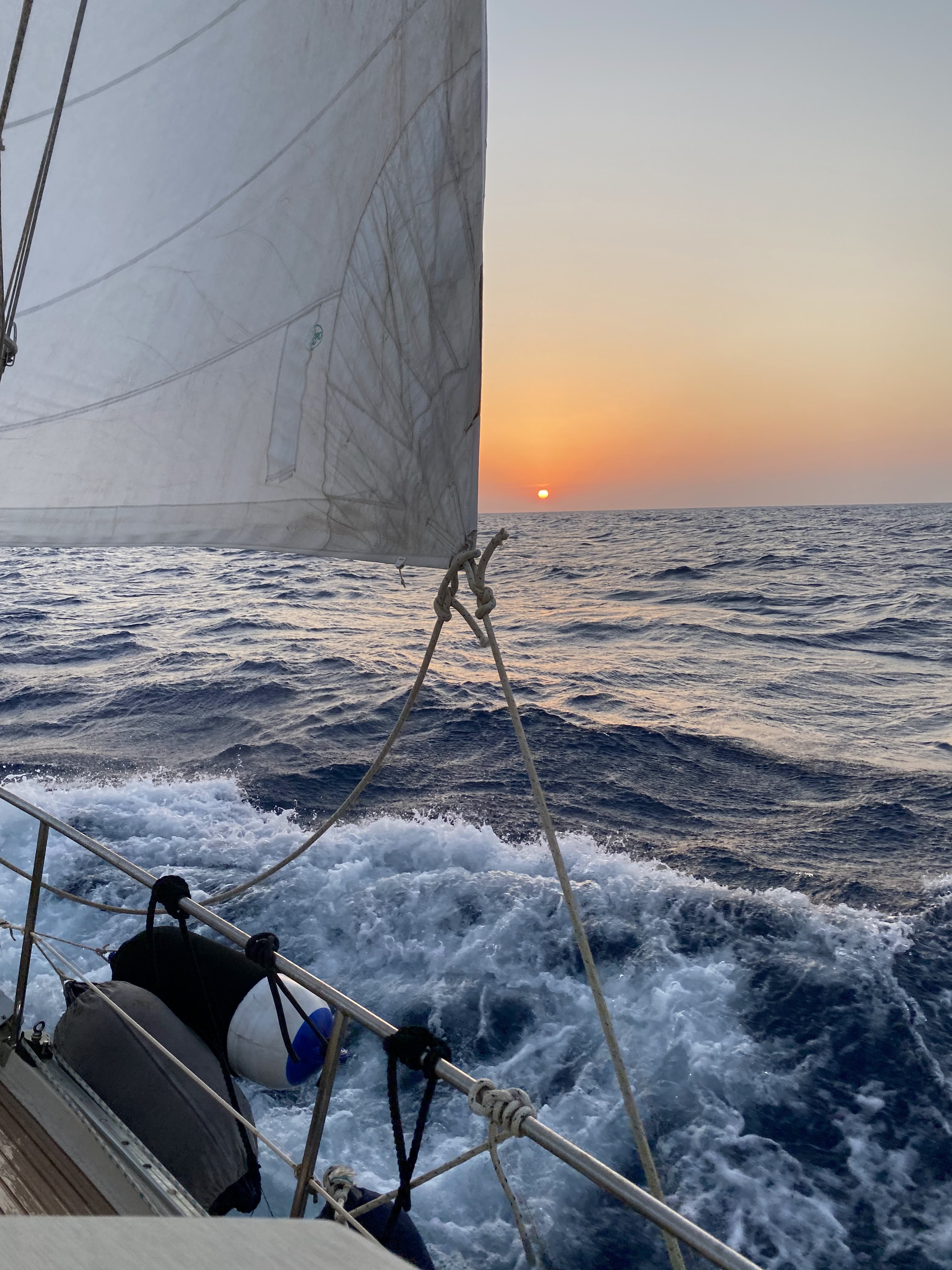
After we got just north of Crete, we finally got our expected wind….and it was even a bit more than expected! We had just had the bottom of the boat cleaned, and this was probably as fast as can go (8.6 knots is hull speed for our waterline length and essentially the max water speed for the boat):

I had all the sails out and we were zooming! I eventually pulled in the main sail to flatten the boat but it was a ton of fun. The only bad thing was that around this time I discovered that our friend’s boat, a slightly older Amel but almost identical to ours, was a bit faster than Spruzzo!
I didn’t accept this at first and started hand-steering (usually I would just let the auto-pilot follow a course) to get every little bit of extra speed I could, but eventually I gave up. Probably the biggest issue is that we have a fixed propeller….which is like dragging a dinner plate behind your boat. Apparently this has about a 0.5 knot penalty. (The other boat’s propeller blades fold themselves to reduce drag.) Next thought was that his sails were original Amel, and while very old by now they still looked like they were holding their shape nicely. My sails are newer but not as well made. Finally there is a slight possibility that my friend who has had his boat for 10+ years is just a better sailor than me ;-).
I think this was our best day of sailing yet. We sailed almost the entire way at 5 to 8 knots for 14 hours. The boat was probably heeled over at 15-20 degrees for most of the way which is normal, but when I went down into the boat, which I did several times, it was almost like climbing rather than walking. Everything is pitched sideways, and the boat is bouncing around a bit unpredictably, and you need to be hanging on to something while you climb around inside. (Note the Amel is a big heavy boat and supposed to have a ‘sea kindly‘ motion…..lighter boats would be worse!) Moving while carrying something is doubly-difficult because you don’t have a free-hand and you have to time releasing your grip before grabbing something else. It is very tiring. Around noon (7 hours of sailing) I was very tired and wondering how those people who sail for weeks at a time by themselves manage! I have read that they take 10 to 15 minute naps, so I set my phone alarm first for 10 minutes and then 15, and would then look around to make sure all was well while I closed my eyes and sometimes napped. This helped a bit, but OMG I could not imagine doing this for days. Eventually poor Victoria emerged. She was feeling sea-sick, but managed to make it up on deck which let me take some longer breaks.
Now I also have better solar/battery/power monitoring on the boat, so I was able to see how much energy the boat was using (autopilot/instruments/fridges) and how much the solar panels were generating. I also have a propeller shaft generator, which uses the spinning motion of the propeller to generate electricity. At over 8 knots of boat speed the boat was powering itself! I thought this was amazing, and imagined what I would need to do to make the boat totally autonomous (the mainsail could be pulled out and in automatically, the jib could come out automatically (but not put back), the mizzen is fully manual right now) which would be doable. The boat has AIS (see other AIS equipped boats) and radar, but would need something to ‘look’ around for items that don’t show up on either (small boats or debris).
Now 8 knots of boat speed (from lots of wind) is not always normal to allow the boat to self-power, but the solar panels did very well as well. It looks to me like from June to September I will only need to run the generator to make water (I have 2x3000w inverters than can be put in series to provide 6000w but I haven’t done that yet). Anyway my point is that the boat could be made almost autonomous! Spruzzo would just need someone to do maintenance. Maybe she could take interesting photos of the Greek islands and sell them for money to fund herself 😉 Or provide an AI-based boat chartering service!
A few hours offshore Crete and we passed a 200m container vessel (about 1.5 km away when closest….still looked huge) and then 2 fishing boats (the fishing boats were going in opposite directions over almost exactly the same spot so that must have been a good fishing spot) which got me thinking about how larger boats move around, how much energy it takes to move and whether they could get that energy organically (i.e by ‘eating’ fish). (Note: the military has done research around robots getting energy from organics on the battlefield.)
A quick google and I’m going to assume that a typical container ship uses 60,000 gallons of diesel a day when moving (there were ranges of data but let’s assume this is ballpark correct). A gallon of diesel contains 35,000 large calories (a food calorie is a large calorie), so a container ship uses 2.1×10^9 calories a day. (Fun fact: human fat and gasoline have similar energy density/weight. Gasoline is higher but fat is close. Our bodies are quite efficient!) Let’s say there are 1000 calories in a pound of fish/seafood (again round numbers) so a container ship would need to eat 2.1 million pounds of fish/plankton per day to move around assuming we had the technology to turn fish into useful energy. A blue whale eats 8000 lbs of krill/day or around 260 times less than our container ship. I just found that a 5-man commercial fishing vessel with a net out for 2 hours can pull in 3000 lbs of fish per ‘catch’ . Even if we could do this 6 times/day (and my math is correct) we are far, far from enough calories/energy for our organically powered container ship. Still an interesting thought.
In any case we safely arrived at our first beautiful anchorage in Astypalea.
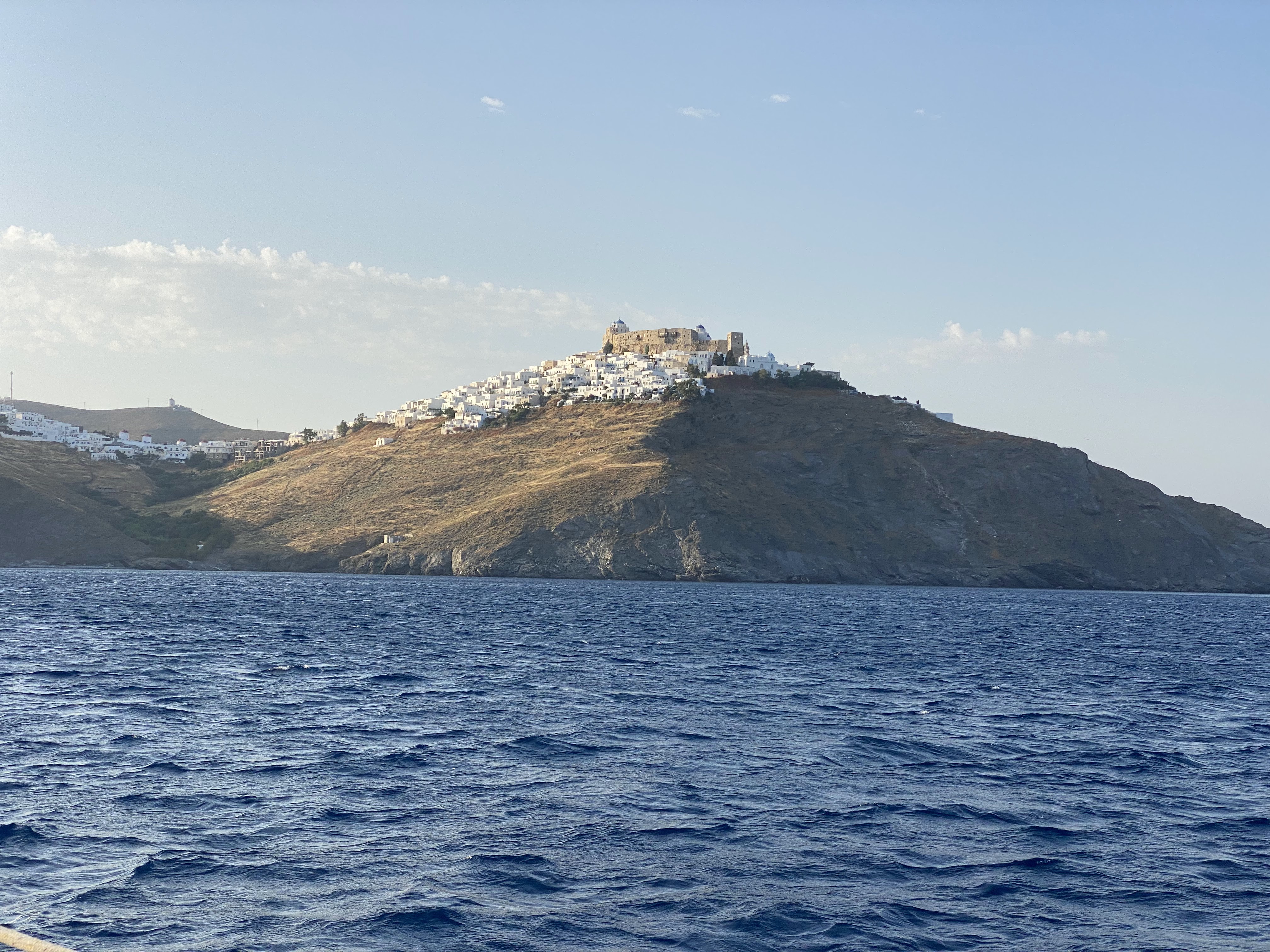
We are now anchored in a beautiful bay. I’m going to dive and check the anchor later today, but I’m sure it is fine. It will be my first swim of the summer! Our plan is to keep heading northish (stopping at lots of islands), and then head south back to Crete for the winter. Stay tuned for more adventures.
 Adventures on Spruzzo