
There are few things more satisfying in life than discovering, quite by accident, that the rituals of one’s childhood—those that seemed merely quaint or mischievous at the time—are in fact the ancient echoes of civilizations long past. As a child growing up in Greece, I recall the neighborhood’s yearly transformation come late June. We children, flushed with sun and mischief, would gather the flower wreaths we had so earnestly crafted on May 1st—now dry and brittle—and toss them onto blazing fires. Then, like Dionysian sprites in sneakers, we would leap over the flames, shrieking with delight and a touch of bravado.
Little did we know we were dancing with the gods.
This midsummer fire-leaping frenzy, now synchronized with the feast of Agios Ioannis (Saint John the Baptist) on June 23rd and 24th, is in fact a vestige of an ancient Greek tradition known as Klidonas (Ο Κλήδονας)—a custom as old as Homer, and as mysterious as the oracles themselves.
The word Klidonas (κλήδων) appears in texts dating back to around 1500 BCE. It appears in Homeric verse and in the works of Pausanias. Klidonas refers to a prophetic sound or omen, often a word or occurrence believed to foretell one’s fate. In Homer’s Odyssey, for example, Penelope interprets a sneeze—yes, a sneeze!—as a divine sign. That sneeze was a klidonas.
Ιf sneezes and signs seem a trifle too whimsical for modern sensibilities, bear in mind that in a world without Tik Tok algorithms or dating apps, people had to rely on whatever mysterious clues the universe threw their way. And so, on the eve of Agios Ioannis, the girls of the village—especially those of matrimonial age—would engage in a peculiar and poetic rite: they would draw water from a well or spring in silence (hence αμίλητο νερό, “silent water”) and place into it personal tokens, often belonging to the young unmarried women of the village. The jug with the “silent water” was sealed with a red cloth and had to remain under the stars all night for the magic to take effect. It could not be exposed to sunlight, or the spell would be broken. The next day, amid much ceremony, fire, and playful songs, the tokens were drawn—each accompanied by a verse meant to reveal the maiden’s future husband.
If this sounds like something between Shakespearean comedy and a reality show hosted by Apollo himself, you’re not far off.
The Orthodox Church, in its pragmatism, chose to baptize this ancient custom—quite literally—by tying it to Saint John the Baptist, patron of purification and asceticism. Thus, a pagan ritual survived by donning the cassock of Christian tradition. The flower wreaths we made on May 1st, originally symbols of spring’s fertility and rebirth, were consigned to flame as a symbolic cleansing—an agricultural New Year’s Eve, so to speak.
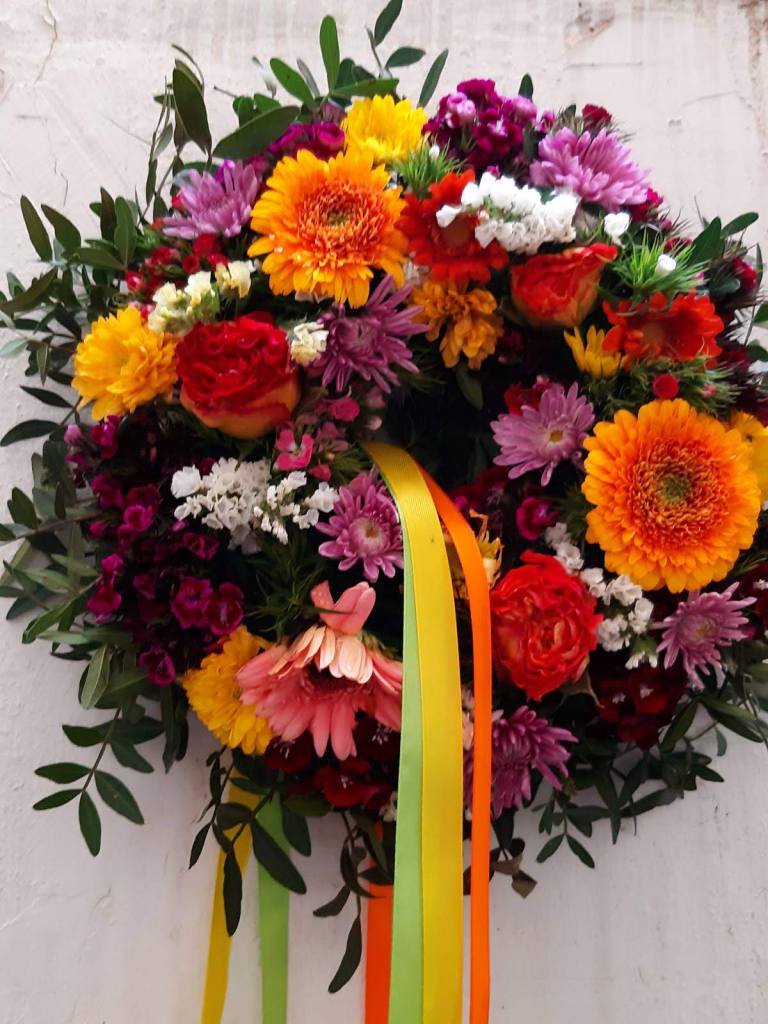
The fire was no idle spectacle. It was purification, it was transformation. And we children, bounding over the flames, were unwitting participants in a 3,500-year-old act of cultural continuity. Each leap was a pact with history.
Today, Klidonas may not feature in travel brochures or Instagram itineraries. But in quiet corners of Crete, Lesvos, Kos and beyond, you may still find it flickering to life in a summer dusk—the scent of smoke and thyme in the air, the clink of silent water in a ceramic jug, the laughter of girls peering into a basin for signs of love.
Sitting on our sailboat now, with the sea gently lapping at the hull and Darcy—six months old and endlessly curious—sniffing at ropes and shadows, it’s clear that those old traditions still speak to something timeless in us. Maybe it’s the magic of the waves, or simply the way quiet moments on the water make space for old stories to resurface.

Jeff usually rolls his eyes the moment I bring up these kinds of stories – somewhere between amusement and mild exasperation. However, beneath the hot Aegean sun, anchored in a bay, away from everything and everyone, there’s a quiet sometimes that makes even Jeff pause and listen.

 Adventures on Spruzzo